Today, we’ll look at hawthorn’s physical support for the cardiovascular system, as well as its role in emotional healing, resilience, and long-term cardioprotective health.
Crataegus spp, Rosaceae family
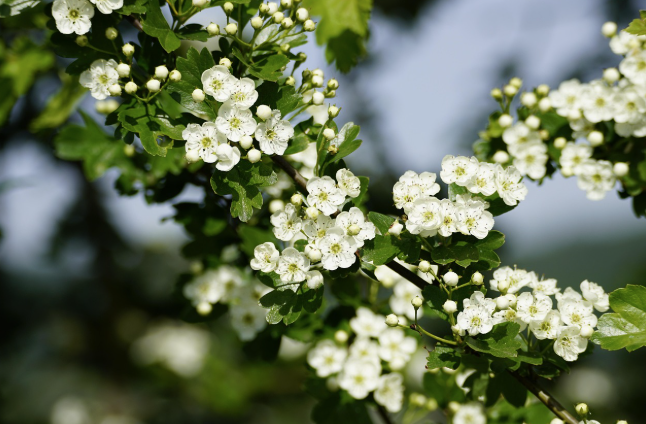
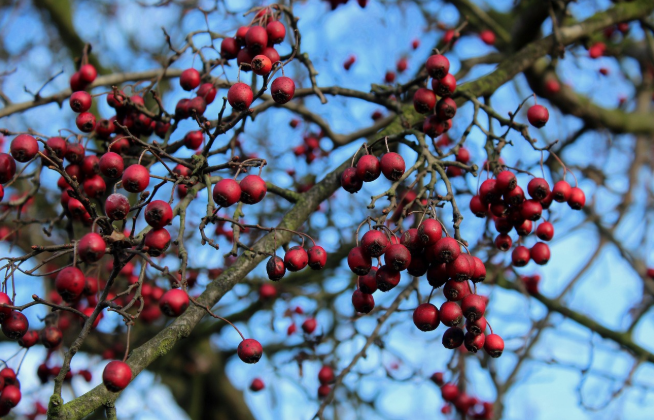
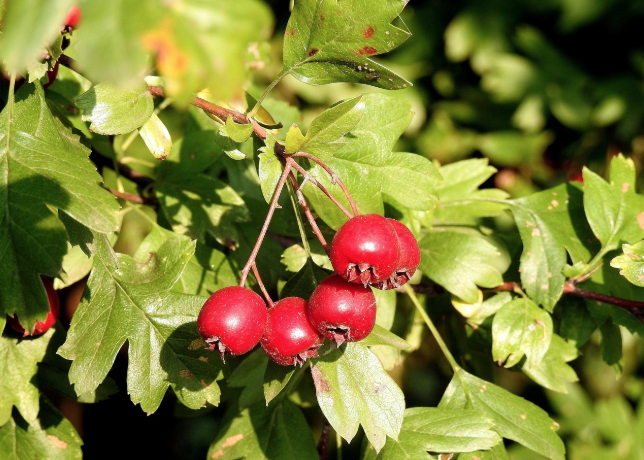
History & Growing: Hawthorn is a shrubby tree known for its sharp thorns – a trademark signature of the Rosaceae family – along with bright white spring flowers and plump red berries that mature in late summer and fall. There are over 250 species of hawthorn worldwide. Native to North America, Europe, Asia, and parts of Africa, hawthorn can be found across many regions of the world.
I am growing Crataegus douglasii, a species native to my Pacific Northwest region that typically reaches heights of 15–20 feet. This variety grows well in both sun and partial shade, so I planted mine a few feet from my deck, alongside other boundary shrubs. Its placement allows me to easily harvest the leaves, flowers, and berries throughout the seasons.
Parts Used Medicinally: Leaves, flowers, and berries
Supplementation Forms: Tea, decoction, tincture, syrup, honey, glycerite, oxymel, cordial; berries have been enjoyed culinarily in many ways: eaten fresh, added to savory dishes, or transformed into jams, wines, fruit leathers, and other condiments.
Taste: Sweet/Sour, Astringent, Mildly Bitter
Energetics: Cooling
Actions: Aerial portions & berries have similar actions, but the leaves/flowers have a stronger affinity for supporting circulation while the berries have a stronger affinity for the heart & blood pressure
- Cardiotonic & Cardiac Trophorestorative
- Cardiac Amphoteric
- Hypotensive
- Nervine relaxant
- Digestive/Stomachic
- Mild diuretic
- Antioxidant
- Astringent
- Vasodilator
Key constituents: OPC’s (oligomeric procyanidins) flavonoids, terpenoids
Organs & Body Systems Herb Acts Upon:
- Heart & Cardiovascular System
- Hawthorn also supports the nervous system particularly when the heart is involved, such as anxiety felt in the chest/nervous palpations
- As an astringent, hawthorn can also be applied topically in salves, serums, and poultices. In this context, we can assume hawthorn also has an affinty for the skin.
Traditional Uses:
- Digestive support: In Chinese medicine, hawthorn has been used for stagnant digestion, while classic herbalists like Dioscorides employed it for upset stomachs, including diarrhea. Native American traditions also included hawthorn for digestive complaints. It can be used for indigestion and/or stomach cramps or pain. [1, 2]
- Cardiovascular support: Early American herbalists used hawthorn for inflammation and heart conditions such as endocarditis, myocarditis, and pericarditis. Folk medicine additionally applied hawthorn to manage dropsy (fluid retention often associated with heart failure). [1]
- Other uses:
- Hawthorn has significant spiritual and folkoric ties, most centering on protection from evil. [11]
- Hawthorn blooms in May and has long been associated with May Day and Beltane celebrations, symbolizing fertility, renewal, and the return of life. Its flowering branches were traditionally used in village festivities, including decorating Maypoles
- In European folk tradition, hawthorn was considered a powerful and liminal tree, closely associated with the fairy realm. It was widely believed to be unlucky to bring hawthorn branches indoors, as doing so would invite magic/otherworldy forces.
- Hawthorn also holds a place in marriage symbolism. In ancient Greece, hawthorn branches and wreaths were used in wedding ceremonies as a symbol of fertility, chastity, and prosperity.
- Hawthorn also carries powerful Christian symbolism. While the Bible does not specify the plant used for the Crown of Thorns, many believe it was made from hawthorn, worn by Jesus during the crucifixion. English legend further connects hawthorn to Joseph of Arimathea, claiming the Glastonbury Hawthorn sprang from his staff and flowered miraculously in winter.
- According to Andrew Chevallier, hawthorn was traditionally used in Europe as a diuretic herb. It was used for kidney and bladder stones. He credits an Irish physician at the end of the 19th century for discovering its affinity for the heart.
- Hawthorn’s modern use as a cardiac remedy is most commonly traced to Dr. Green of Ennis, Ireland, a late-nineteenth-century physician whose clinical application of Crataegus for functional heart weakness helped establish the plant’s reputation as a gentle heart tonic (Weiss; Wood)
- According to Herbal Reality, hawthorn was traditionally used to reduce fevers and help stabilize body temperature.
- Hawthorn remains an important heritage food herb in the Native American culture.
- The Crows referred to berries as “old peoples’ medicine” and honor the hawthorn tree with the mocassin dance before harvesting.
- Hawthorn has been used as a form of coffee, in breadmaking, added to soups, stews, and sauces, and in various medicinal preparations ranging from digestive support and arthritis to macular degeneration and support for the heart. [9]
- Hawthorn has also traditionally been used for fashioning tools, boxes, staffs, and fencing.
- Hawthorn has significant spiritual and folkoric ties, most centering on protection from evil. [11]

Current Uses (& Studies/Research):
- Heart & Cardiocascular System:
- Hawthorn is high in flavanoids and OPC’s that help improve blood flow to the heart by relaxing and dilate arteries. It is also high in protective antioxidants that can help reduce – or prevent – breakdown or damage to blood vessels. As such, hawthorn is widely used to support numerous heart conditions, such as hyper- AND hypo- tension (speaking to hawthorn’s amphoteric actions), tachycardia, angina, atherosclerosis, and irregular heartbeat. [1, 2, 3]
- Hawthorn may help lower cholesterol. Animal studies have shown hawthorn’s promise here!
- Hawthorn supports circulation to extremities, and can be called upon for relieving symptoms related to poor circulation (edema in extremeites, Raynaud’s, chilblains)
- Per Rosalee de la Foret: “Research concludes what herbalists have long known, that ‘hawthorn has a clear benefit for patients with mild to moderate heart failure.’”
- Hawthorn’s ability to safely improve heart health is highly researched and well documented.
- A systematic review and meta‑analysis of placebo‑controlled clinical trials found that hawthorn extract improved exercise tolerance and physiologic outcomes in patients with mild to moderate chronic heart failure when used alongside conventional treatment. Symptoms such as shortness of breath and fatigue were significantly improved compared to placebo. [4]
- A published review confirmed that research into hawthorn’s cardiovascular effects largely results in positive outcomes, with standardized extracts showing promise for symptom improvement and improved quality of life in patients with cardiovascular disease. The herb is considered safe with infrequent, mild adverse effects.[5]
- A clinical evidence review noted that multiple double‑blind, placebo‑controlled randomized trials suggest hawthorn extract can be useful as an adjunct to conventional therapy for chronic heart failure, improving heart function and symptoms compared to placebo. [6]
- In a randomized controlled trial of adults with type 2 diabetes, daily hawthorn extract (1200 mg) for 16 weeks significantly lowered diastolic blood pressure compared to placebo, without herb‑drug interactions [7]
- Nervous System:
- Hawthorn as a nervine is interesting. This is where herbal medicine, in my opinion, reigns supreme. While hawthorn has scientific evidence supporting its effects on the physical heart, its traditional use in herbalism for supporting those experiencing grief, trauma, or loss remains meaningful. By gently strengthening and nurturing the heart, it helps soothe an anxious or overactive nervous system, bringing a sense of calm and steadiness offering gentle healing that no lab test can measure. Its primary affinity for the heart makes it uniquely suited to provide emotional as well as physical support, helping us process difficult emotions while supporting cardiovascular resilience.
- Hawthorn combines well with other nervine herbs with an affinity for the heart, like Motherwort and Linden. Milk oats and Lemon balm are other great herbal pairings for the nervous system. Combined with nootropics, like gingko, hawthorn can be used for increased blood flow to the brain to support focus and memory. [10]
- Topical Applications & Skin Care:
- As an astringent and tonifying herb high in antioxidants, hawthorn berries and flowers can help sooth inflammation while protecting skin from damage and signs of aging.
- This application is new to me! I plan to infuse hawthorn flower into my rose hip serum along with calendula and elder flower on my next batch, or try it in my Queen of Hungary facial toner.
When to Reach for Herb & In What Form:
Listen, we can ALL benefit from hawthorn for our hearts, especially stressed-out athletes! ESPECIALLY stressed-out athletes with a family history of heart conditions!
Hawthorn is a tonic herb, which means its benefits come from consistent, daily use over weeks or months. A few cups of tea or a couple of droppers of tincture here and there won’t create an acute effect but, over time, the herb works steadily to support heart function, circulation, and emotional balance.
The key is to find a form you enjoy consuming daily:
- Stir hawthorn honey into your tea (heck make it hawthorn tea!) or drizzle it over oatmeal
- Spread hawthorn jam on toast
- Take a couple of droppers of tincture in a glass of water morning and evening for simplicity
Regular, enjoyable use is the best way to integrate hawthorn into your routine and reap its gentle, long-term benefits.
Dosage & Preparation: As advised by auther & herbalist, Rosalee de la Foret, hawthorn is a food herb that can be consumed daily, often in higher, food-like doses, for best results. [2]
- Tea or Decoction: 1-2 teaspoons dried leaf, flower or berry per 8 oz of water 1-3 times per day.
- Up to 30 grams of the leaf, flower, berry per day
- I use hawthorn aerial portions as a base herb in my Snowberry Solstice Brew! 🙂
- Tincture: 5 ml doses consumed 1-3 times per day
- Tincture ratio for fresh berry – 1:1 @ 40-60% ABV
- Tincture ratio for dried leaf/flower – 1:5 @ 30% ABV
- I have not tinctured hawthorn berries yet. As soon as my tree begins producing them, I plan to make a fresh berry tincture and continue using the dried aerial portions for tea.
Special Considerations: Hawthorn is an incredibly safe herb! However, its use can compound the strength of certain medications (particularly relative to the heart/blood) so supplementation should always be closely monitored and communicated with a practitioner. Some people with heart conditions may try to self-medicate with hawthorn instead of recieving proper diagnosis, monitoring, and treatment, which is not advisable.
Elemental, Planetary & Dosha Discussion:
- Element: Fire [3]
- Planet(s): Culpeper: Mars, Sajah Popham: Sun, Others: Venus
- Dosha: Hawthorn balances the heat of pitta, and grounds + calms the nervousness of vata. It may also help move stagnation-prone kapha, but overly sweet preparations are not recommended.
Recipe of the Week: Hawthorn Heart Tea
Ingredients:
1-2 teaspoons of each herb (dried, organic recommended):
- Hawthorn (leaf, flower, and/or berry)
- Rose (petals or hips)
- Cinnamon (chips, or a cinnamon stick will do!)
- Rooibos or Tulsi
Directions: Combine herbs in a tea ball or infuser pot. Cover with hot water and allow a long infusion (30+ minutes). Strain, sweeten with hawthorn honey or elderberry syrup, and enjoy! *You may want to rewarm your tea for 30 seconds or so if you allow a long infusion 🙂
Citations & Recommended Reading:
- Hawthorn, Herbal Reality
- Hawthorn Uses and Plant Monograph, Learning Herbs by Rosalee de la Foret
- Evolutionary Herbalism by Sajah Popham
- Pittler MH, Schmidt K, Ernst E. Hawthorn extract for treating chronic heart failure: meta-analysis of randomized trials. Am J Med. 2003 Jun 1;114(8):665-74. doi: 10.1016/s0002-9343(03)00131-1. PMID: 12798455.
- Tassell MC, Kingston R, Gilroy D, Lehane M, Furey A. Hawthorn (Crataegus spp.) in the treatment of cardiovascular disease. Pharmacogn Rev. 2010 Jan;4(7):32-41. doi: 10.4103/0973-7847.65324. PMID: 22228939; PMCID: PMC3249900.
- Guo R, Pittler MH, Ernst E. Hawthorn extract for treating chronic heart failure. Cochrane Database of Systematic Reviews 2008, Issue 1. Art. No.: CD005312. DOI: 10.1002/14651858.CD005312.pub2.
- Walker AF, Marakis G, Simpson E, Hope JL, Robinson PA, Hassanein M, Simpson HC. Hypotensive effects of hawthorn for patients with diabetes taking prescription drugs: a randomised controlled trial. Br J Gen Pract. 2006 Jun;56(527):437-43. PMID: 16762125; PMCID: PMC1839018.
- Washington Hawthorn : Cultural History
- Native Memory Project: Black Hawthorn
- Encyclopedia of Herbal Medicine, Andrew Chevallier
- Product: Hawthorn, Mountain Rose Herbs
- Weiss, Rudolf Fritz. Herbal Medicine. Beaconsfield Publishers, 1988.
- Wood, Matthew. The Earthwise Herbal: Old World Medicinal Plants. North Atlantic Books, 2008.
 Kawaoka Coaching
Leave a comment