Arctium lappa, A. minus
Family: Asteraceae
History & Growing: Native to Europe, Asia, and North America, burdock has been a classic food herb and remedy for thousands of years. A rambunctious weed with a long taproot, burdock is a biennial plant so it will only stick around for two years. It is recommended to harvest the root in the fall of its first year. [3] In its second year, burdock will sprout a flower stalk that can reach 3-6 feet tall. The purplish burrs on the flower stalk inspired the invention of Velcro! It is not overly fussy about soil types or sun exposure – the roots are notoriously back-breaking to harvest! Wild burdock growing in tough terrain makes the best medicine. “Arctium” is derived from the Greek word arkos, which means bear. Burdock, or Gobo, is widely available at health stores and Asian markets; it looks like a long white carrot!

Parts Used Medicinally: Root (most common in Western herbalism), Seed (said to be acrid)/ Fruit, Leaf (leaf said to be quite bitter)
Supplementation Forms: As a food/vegetable, decoction, tincture, poultice
Taste: Sweet, Salty, mildly bitter, oily
Energetics: Neutral- slightly cooling in temperature, neutral moisture [1]
Actions:
- Alterative
- Anti-inflammatory
- Antimicrobial
- Antirheumatic
- Mild bitter tonic
- Diuretic
- Cholagogue & choleretic
- Lymphagogue
- Hepatic & hepatoprotective
- Laxative
- Vulnerary
- Seeds: diaphoretic
Key Constituents: INULIN (prebiotic sugar), bitter glycosides, flavonoids, tannins, polyacetylenes, volatile oil, lignans [5]
Superpower: A cleansing, nutritive root, burdock is associated with finding your “true roots” and authentic self. Burdock can help break from toxic patterns and ground yourself in your inner strength, building your vitality so you can start trusting your “root instincts”
“On a psychological level, Burdock helps us deal with our worries about the unknown… which lurk in the dark woods beyond our control. It seizes upon deep complex issues, penetrates to the core and brings up old memories and new answers. It gives us faith to move ahead on our path, despite the unknown problems that might snare us on our way. It helps the person who is afraid become more hardy, while it brings the hardy wanderer back to his original path. It restores vigor and momentum.”
~ Mathew Wood [1]
Organs & Body Systems Herb Acts Upon:
- Liver/Digestive System
- Blood
- Lymphatics
- Skin/Sebaceous glands
- Kidneys
Traditional Uses:
- Considered one of the top detoxifying herbs in herbal medicine
- Culpeper recommended it for those “bitten by a mad dog”
- Gout, fever, kidney stones [5]
- “Nicolas Culpeper wrote the seed is much commended to break the stone and cause it to be expelled by urine “[5]
- Cancer
- Rosalee de la Foret writes that burdock “has been famously used for people with cancer for at least a hundred years. It was a main herb in the two famous cancer formulas from the 1920s: Essiac and the Hoxsey formula.” [3]
- Skin conditions (acne, eczema, psoriasis)
- Prolapsed uterus & Venereal disease (syphilis)
- In TCM, burdock is used to “clear heat and relieve toxicity” in congested/toxic conditions [4]
- Seeds (diaphoretic) have been used for feverish conditions, boils, abscesses and throat conditions. Recently used for diabetes and in Japan for cancer support
- Burdock has been used with sheep sorrel, slippery elm, and rhubarb root in the ESSIAC formula developed by a Canadian nurse (Rene Caisse)
- Native Americans use the herb as a food vegetable, and also used it for skin health and medicinal baths [7]
- Topical poultice for skin conditions like poison oak/poison ivy or as a therapeutic wash for the skin [7]
- A necklace made from the root gathered during a waning moon was thought to offer protection from evil and negativity [7]
Current Uses (& Studies/Research):
- Purifying and cleansing actions for general detoxification, health & nutrition; to support chronic skin conditions, namely hot/inflamed or weeping ones
- Action on sebaceous glands: Some herbalists (Popham, mcdonald) feel burdock supports sebaceous gland secretions, making it great for dry, itchy, scaly skin problems.
- Sajah Popham considers it to be an “amphoteric” for sebaceous glands, meaning it works both ways in terms of balancing: burdock supplementation may increase secretions when dry and help mitigate secretions when excessively damp/overly secreting/oily. [1]
- Herbalist jim mcdonald uses the term “sebaceous gland diaphoretic” when describing the seed, and discusses how the body employs oily sweat as s defense against the cold and damp, almost like insulation. As a diaphoretic with an affinity for the sebaceous glands, utilizing the seeds to remedy skin conditions can have a profound effect. [3]
- Action on sebaceous glands: Some herbalists (Popham, mcdonald) feel burdock supports sebaceous gland secretions, making it great for dry, itchy, scaly skin problems.
- Nutritive + Digestive stimulation and overall support /absorption of nutrients
- Action on liver: as an oily herb with mild bitter properties, burdock stimulates the liver. The liver is responsible for producing bile, which aids in the emulsification and absorption of fats and other nutrients. The more bitter the root, the stronger the action on the liver & digestive system. Note: the liver helps regulate hormones by producing AND excreting excess hormones; hepatic herbs can support hormone imbalance by stimulating the livers.
- Action on gallbladder: Burdock also has an affinity for the gallbladder, an organ responsible for storing and then secreting bile (made in the liver) to break down, absorb and eliminate fat. The gallbladder releases bile into the small intestine when you consume fat, which is why the oiliness and bitterness of burdock stimulates the gallbladder and has a widespread action on the digestive system.
- Action on the blood: burdock supports the blood by “keeping extracellular fluid and lymph healthy, contributing to overall metabolic balance.” [1]
- Nutritive: Burdock is high in inulin, a prebiotic that feeds beneficial gut bacteria. Consuming foods high in inulin can relief constipation, help improve blood sugar regulation in people that are prediabetic or diabetic, and improve mineral absorption and bone health. [8]
- Useful for arthritis, rheumatism, gout, reproductive issues, hypertension, kidney afflictions like stones and urinary complaints, but also general health and wellness!
- Studies:
- Studies from Germany and Japan showed polyacetylenes found in the root had an antibiotic effect [5]
- Burdock has antibacterial, antifungal, diuretic and hypoglycemic effects and may contain antitumor action; studies suggest seeds are anti-inflammatory, hepatoprotective and antioxidant [5]
- Several studies have been done on constituents of burdock on their action on cancer cells with positive and very encouraging results, though no human clinical trials have been done. [3]
- “In the root, the active ingredients have been found to “detoxify” blood in terms of TCM and promote blood circulation to the skin surface, improving the skin quality/texture and curing skin diseases like eczema. Antioxidants and antidiabetic compounds have also been found in the root. In the seeds, some active compounds possess anti-inflammatory effects and potent inhibitory effects on the growth of tumors such as pancreatic carcinoma. In the leaf extract, the active compounds isolated can inhibit the growth of micro-organisms in the oral cavity. The medicinal uses of burdock in treating chronic diseases such as cancers, diabetes and AIDS have been reported.” [2]
When to Reach for Herb & In What Form:
- Decoctions are time consuming, but ultimately the best. I didn’t love the taste of the decoction (tasted like sweet carrot water!) and have used the tincture more often.
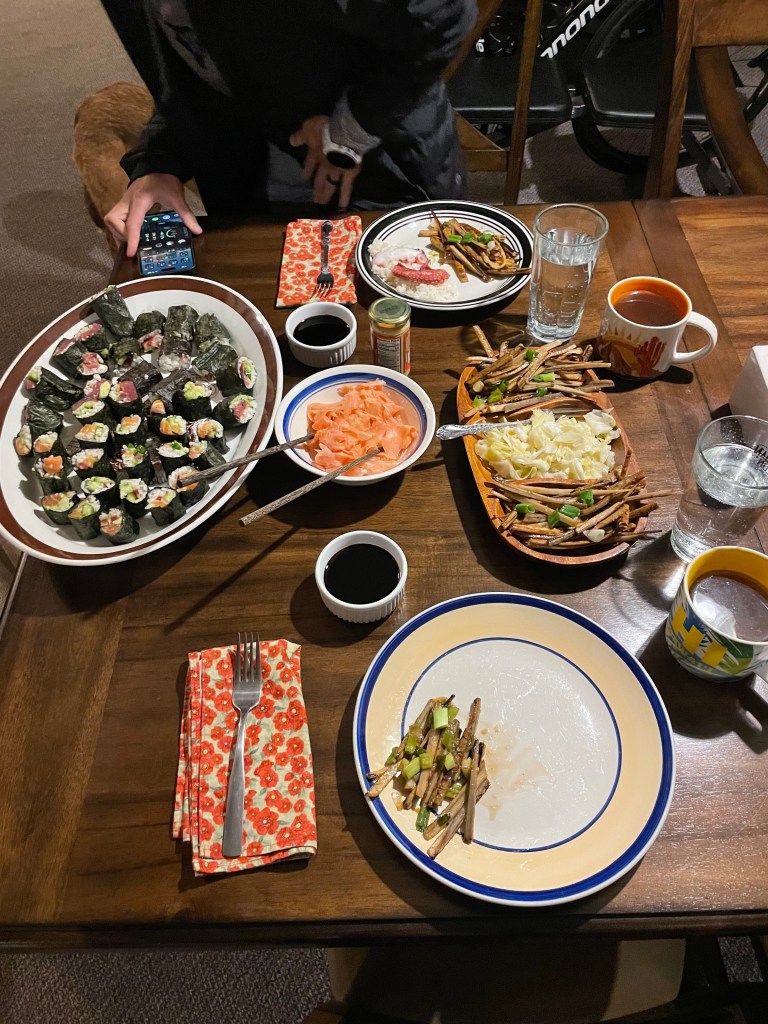
- Consuming it as a food is likely the easiest way to supplement it long term! As a vegetable, there’s no recommended serving but be warned: eating large amounts can make some people gassy! Chop and add it to stir-fry, soup, rice, or try fermenting it in vinegar, similarly to kimchi. I enjoyed it thinly sliced, stir fried, and tossed with soy sauce and green onions. [3]
Dosage & Preparation:
- Best prepared as a decoction: Cover 2 TB dried burdock in 2 cups water and simmer gently for 15 minutes, then remove from heat and allow to steep for another 40 minutes. [1] When consuming the root as a decoction 15-30 grams/day is considered an appropriate medicinal dose range [3]
- Water extraction is the best way to get all the good nutrients and medicinal properties from burdock!
- If you’re going to the work of making a decoction, it does help to make a large batch with other “decoction” herbs like dandelion root, oat straw etc. then tossing in other mineral rich herbs like nettle for the steeping portion. Then you can strain and store in fridge for a few days!
- To tincture, use a lower % alcohol to extract as much of the constituents as possible. I did mine at 1:5 @ 40% alcohol and discovered a cloudy white substance settle at the bottom of the finished product – that’s the inulin!
- Adding it to bone broth is another way to get a lot of medicinal value! I haven’t tried this, but I have cooked it as a side dish and it tasted a lot like carrots! (its widely available Asian grocery stores as Gobo, however it was unclear if it was organic or not so I hesitated to use it as a medicinal.)
Contraindications:
- Skin conditions may be aggravated at the initial use of burdock (common with alterative supplementation) Start with a low dose and consume with herbs that support elimination [3]
- Those with Asteraceae allergies should use caution
- Avoid consuming/ use caution with burdock seed consumption when pregnant or lactating, however this is one herb that can be safely consumed during pregnancy (modest dosage with supervision) [6]
Elemental, Planetary & Dosha Discussion:
- Jupiter!
- Oily alterative with action on the liver, large growing style that likes to take up space.
- Culpeper attributed this herb to Venus, and felt it was feminine in nature [7]
- Earth!
- Growing style, nutritive sweet/salty/mineral content, root
- Perhaps most kappa-like in nature, burdock is effective for all doshas and – since its generally pretty mild + energetically and moisture neutral – it’s a good balancing herb suitable for long term supplementation. Burdock is an ideal remedy for both dry/atrophy AND damp stagnation; its also effective for heat patterns without being particularly cooling. Burdock is really great at balancing conditions without leaning too much one way or the other – it sort of meets the body where it is and helps it sort itself out! As such, Sajah Popham concludes this is a “tridoshic” herb[1]
Citations & Recommended Reading:
- Burdock: The All-Purpose Alterative by Sajah Popham, Evolutionary Herbalism
- Chan YS, Cheng LN, Wu JH, Chan E, Kwan YW, Lee SM, Leung GP, Yu PH, Chan SW. A review of the pharmacological effects of Arctium lappa (burdock). Inflammopharmacology. 2011 Oct;19(5):245-54. doi: 10.1007/s10787-010-0062-4. Epub 2010 Oct 28. PMID: 20981575.
- Burdock Uses & Plant Profile Summary Rosalee do la Foret, Learning Herbs
- Burdock Herbal Reality
- The Encyclopedia of Herbal Medicine, Andrew Chevallier
- Body Into Balance, Maria Noel Groves
- Burdock Mountain Rose Herbs
- What to know about inulin, a healthful prebiotic, Franziska Spritzler, medically reviewed by Atli Arnarson, Medical News Today Nov 22, 2023
- Evolutionary Herbalism, Sajah Popham
Recipe of the Week:
Rooted Formula for Improved Plumbing: This formula supports digestion and elimination while bolstering the reproductive system. Decoct 1 heaping tablespoon of the blend in 8 oz water for 15 minutes (simmer on low with a lid on) then switch off the heat and allow it to infuse for another 15 minutes. Strain and enjoy! Consume 1-2 cups daily (before 3 pm, as eleuthero can be stimulating) for 8 weeks, then take a week off. Alternatively, try this as a tincture blend using each herb’s respective tincturing ratios.
Burdock root 30%
Nettle root 30%
Eleuthero root 25%
Ginger root 10%
Licorice root 5%
 Kawaoka Coaching
Leave a comment