Taraxacum officinale
Family: Asteraceae
History & Growing: Weedy, wonderful dandelion! Dandelion’s name comes from its coarse leaves…someone apparently thought they resemble lion’s teeth and voila- the French phrase “dent de lion” (lion’s tooth) was born. Dandelion is native to Eurasia and Northern Africa but grows all over the world; early colonists brought the beloved medicinal plant with them on the Mayflower(2). Sadly, this herbal powerhouse is often sprayed with pesticides instead of harvested and consumed (imagine how much healthier we would be, and how fewer chemicals we’d be exposed to!). Dandelion, a nutritional powerhouse, has been consumed in various forms for centuries. Let’s dive into all things dandelion!
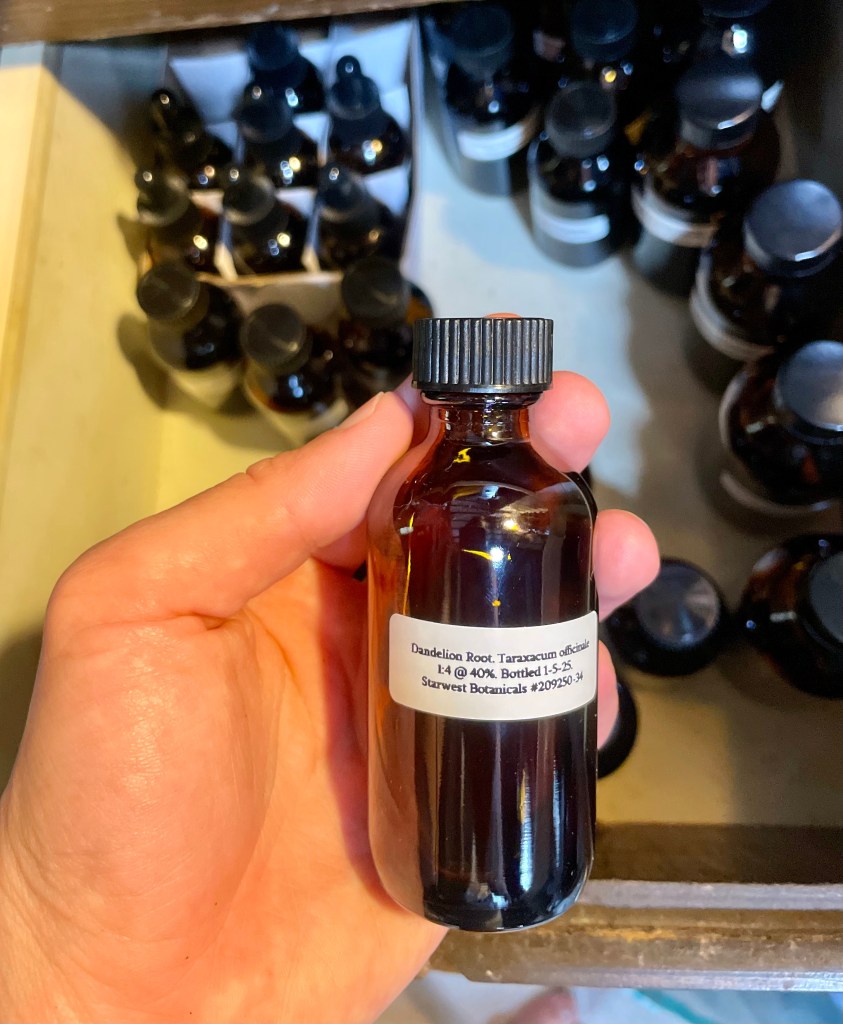
Dandelion tincture
Parts Used Medicinally: All parts: leaf, flower and root
Supplementation Forms: Decoction of the root, tincture of the root, herbal coffee from roasted root, infusion of the leaf and/or flower, infused vinegar (ideal for mineral extraction), culinary edible including salad or cooking greens made from the leaves, wine made from the flowers, herbal bitters (1)
Taste: Root, Leaf & Flower: Bitter! Salty (Leaf) Sweet (Root) (5)
Energetics: Cooling, drying
Actions:
- Root:
- Bitter tonic
- Alterative
- Diuretic & gentle laxative
- Hepatic
- Cholagogue
- Pre-biotic
- Leaf:
- Bitter tonic
- Alterative
- Hepatic
- Cholagogue
- Diuretic
Key Constituents: sesquiterpene lactones, triterpenes, polysaccharides. Leaf: coumarins, carotenoids, minerals (such as potassium, calcium, manganese). Root: taraxacoside, phenolic acids, various minerals (potassium, calcium) (3)
Organs & Body Systems Herb Acts Upon:
- LIVER (root) & digestive system
- Blood & Skin
- Kidneys (leaf) & Urinary System
Traditional Uses:
- Dandelion has long been used to support the liver and digestion. John Gerard speaks of dandelions uses on the stomach and for painful urination in his 17th century publication The Herball
- Dandelion wine was a popular digestive fall beverage. While recipes still circulate today ( I recently came across one in a recipe book, Taste Buds, gifted to me by a friend that I’m dying to try!) it’s likely a slightly less popular drink than in centuries past. While it’s easy enough to make, it does take a few months to ferment!
- Nicholas Culpeper, popular English herbalist and botanist, speaks highly of dandelion and its effects on the liver, gallbladder and spleen.
- William Langham, a 16th century herbalist and physician, used the juice of dandelions as a remedy for baldness.
- Other uses include, but not limited to, use as treatment for fevers, dysentery, and as a general food herb for nutritious value. Dandelion and chicory have long been used as coffee alternatives and substitutes in war times or as caffeine-free options.
- In TCM (Traditional Chinese Medicine) it is a tonic used to clear liver heat. Signs of liver heat include irritability and mood swings, emotional outbursts, dizziness, headaches, bitter dry mouth, red, hot inflamed skin conditions, and digestive complications.
Current Uses (& Studies/Research):
- Liver & Digestion:
- Dandelion is a trusted and beloved liver tonic, and as such has a host of positive impacts on the body.
- Skin & Blood: As an alterative (or “blood cleansing”) herb, dandelion supports the liver, kidneys and digestive tract, making a choice herb for conditions like eczema, acne and psoriasis. Dandelion helps stimulate digestion and elimination, clearing stagnation and the problematic symptoms association with heat, stagnation, and/or dampness.
- Dandelion root, harvested in the fall, is high in inulin, a substance our bodies can’t actually break down but feeds our intestinal gut flora. Inulin is considered a prebiotic. Some people may be sensitive to this, in which case burdock may be a more formidable herb choice.
- As a bitter herb & cholagogue, dandelion can stimulate the production of bile which, in turn, can help lower cholesterol and aid in stagnant digestion and constipation. Dandelion helps get things MOVING! Bitter herbs like dandelion support digestion by increasing saliva, bile, and stomach enzymes, all of which help break down our food and maintain a healthy, balanced body (hormones, etc). Bitter herbs also help stimulate peristalsis, a natural process that helps move food and liquid through our bodies.
- Reproductive System: by supporting the liver, dandelion can help with the metabolism and excretion of excess hormones, dandelion can be an ally for menopausal women, those with ovarian cysts, endometriosis, and more. (1)
- Dandelion is a trusted and beloved liver tonic, and as such has a host of positive impacts on the body.
- Urinary System:
- As a mineral-rich diuretic, dandelion (which is high in potassium) helps reduce water retention/edema without causing an imbalance in nutrients. (1)
- Dandelion leaf has a stronger affinity towards the kidneys and urinary system, and is a popular, effective diuretic remedy.
- Nutritive
- Dandelion root, leaf and flowers are high in vitamins and minerals! It can be consumed long term, and as a food herb. Popular choices include stir fries, salads, smoothie additions, jam, wine, and more! The root (recommended harvest in the fall) can be used like a vegetable and the young spring leaves are a delicious food choice for pesto, salad, etc. Roasted, dried dandelion root makes a wonderful coffee alternative. The flowers are high in lutein (5) which is great for eye health. I’ve baked cakes with dandelion flower infused into the batter and frosting.
When to Reach for Herb & In What Form:
- Dandelion comes to mind for many purposes but here are my main indications for use!
- DIGESTIVE SUPPORT
- If someone is prone to hot, red skin irritations, or stagnation, combining dandelion with other alterative herbs to support elimination may be beneficial. See recipe below! Tincture is simple, but sipping decoctions can also be effective.
- If you want to boost your vitamin and mineral content, consume dandelion!!! The leaves can be made into so many delicious dishes.
- For menopausal women that show signs of estrogen dominance, dandelion can be beneficial alongside other herbs with affinities for hormone balance. Dandelion is cooling, which is a plus when someone is struggling with heat patterns, and supports the liver which may help metabolize and eliminate excess reproductive hormones (1) (5)
Dosage & Preparation:
- 2-3 teaspoons dried root/leaf/flower per cup of water 1-3 times per day (1)
- Tincture: 2-4 ml up to 3 times per day (1)
- Reminder: Root= Liver, Leaf = kidneys/urinary system (nutritive)
Contraindications: Dandelion, nicknamed “piss en lit” (French!) for good reason, is VERY diuretic so use caution if you take medication that interacts with diuretics or is diuretic.
Elemental, Planetary & Dosha Discussion:
- Jupiter Ruler (yellow flowers, action on the liver) Air Element (fluffy seed heads)
- Good for draining fluids and excess heat/excitation, damp heat/ stagnation states, “mapped tongue” (6)
- Can be contraindicated for vata dosha (who tend towards cool/dry constitution)
Citations & Recommended Reading:
- The Healing Garden, Juliet Blankespoor
- The Dandelion, Anne Rothfeld
- The Encyclopedia of Herbal Medicine, Andrew Chevallier
- Alchemical Herb Profile: Dandelion by Sajah Pophan (Evolutionary Herbalism & The Plant Path)
- Dandelion Uses and Plant Monograph, Learning Herbs by Rosalee de la Foret
- Alchemical Herb Profile: Dandelion (Taraxacum officinale) by Sajah Popham
Recipe of the Week: Nutritive Skin Tonic Tea
- 1-2 teaspoons each of dried, organic dandelion root, burdock root, and nettle leaf
- 8 oz water
Simmer the dandelion root and burdock root in water for 20 minutes. Remove from heat and add nettle leaf. Allow to infuse for another 20 minutes. Strain and sweeten to taste. Enjoy hot or cold 1-3 times per day. (you can double the recipe and sip throughout the day!)
 Kawaoka Coaching
Leave a comment