Hypericum perforatum
Hypericaceae (St. John’s Wort) family
History & Growing:
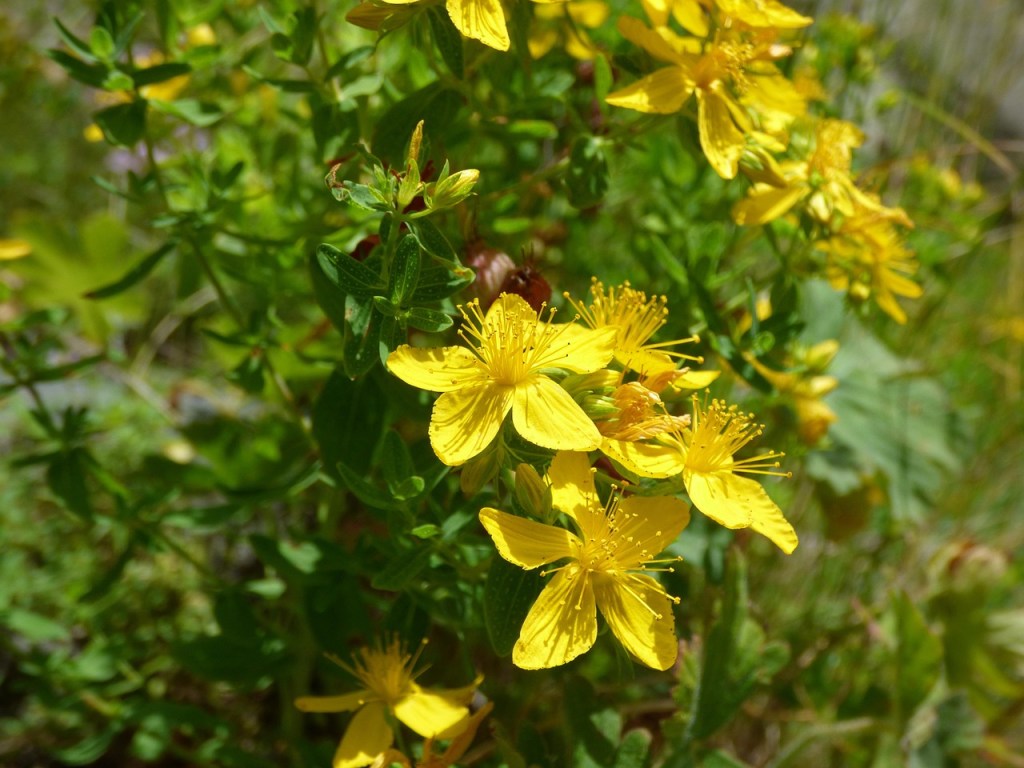
A temperate herb that loves a sunny hillside, St. John’s Wort is a treasured herb with countless medicinal uses. Thought to ward off evil spirits during medieval times, the yellow flowers were harvested on Saint John the Baptist Day in late June (summer solstice) and infused into oil. Freshly picked flowers macerated in oil produce a stunning red infusion. It was, and is still used as, a wound healer and uplifting tonic for downheartedness. It’s recent gain in popularity is largely due to clinical research that supports its use as treatment for mild to moderate depression. St. John’s wort is a flowering, erect perennial that grows up to about 3 feet tall. It can be grown from seed or root division, enjoys full sun, and well-drained chalky soil. I have JUST the spot for this delightful herbal ally, and cannot wait to start my own cluster after using dried, organic St. John’s Wort sourced from Mountain Rose Herbs all winter. It is considered an invasive weed here in Washington State, along with a few other states, so I’ll have to sort out a sustainable growing practice ASAP!
St. John’s Superpower: As a Sun-ruled herb, St. John’s Wort’s super power is strengthening your inner sun, or sense of self, when you’ve lost your way. It has an affinity for healing people from the inside out, bringing light and warmth in times of darkness, cold, and uncertainty.
Parts Used Medicinally: Aerial portions – leaves and flowering tops
Taste: Mild Bitter
Energetics: Warming, fairly neutral in tone*
*Balsamic, slightly drying
Actions:
- Antidepressant: Increases the availability of serotonin, norepinephrine, and dopamine with fewer side effects of medication
- St. John’s Wort encourages calming neurotransmitters to remain in the body for a longer duration, soothing irritability and easing sadness. (Popham)
- St. John’s Wort contains the constituent hyperforin
- Hyperforin not only inhibits the neuronal uptake of serotonin, norepinephrine and dopamine like many other antidepressants, but also inhibits GABA and L-glutamate uptake.
- Müller WE, Singer A, Wonnemann M. Hyperforin–antidepressant activity by a novel mechanism of action. Pharmacopsychiatry. 2001
- Anxiolytic (reduces anxiety)
- Antiviral, antimicrobial
- Anti-inflammatory
- Nervine
- Trophorestorative & Neuroprotective
- Vulnerary
Organs & Body Systems Impacted by St. John’s Wort:
- Brain & Nervous system
- Lymphatic system* (liver)
- Skin
Traditional Uses:
- As a topical wound healer, such as after a knife or sword injury or stab wound.
- As a nerve tonic to relieve “downheartedness”
- As a protective agent to ward off witches, demons and evil spirits! The Genus name in Greek translates to “above the apparition”
- It has many religious ties, including the harvest on Saint John’s Day (June 24) and the oil turning blood-red on the supposed day of his beheading (August 29)
- Harvested flowers left overnight in a bowl of water to capture the Dew of God (believed to fall during the night on the evening of Saint John’s)
- Early gynecological uses, such as urinary tract infections and dysmenorrhea.
- Lung infections associated with fever as well as stomach ailments like ulcers or gastritis.
- Boiled in wine and used for wounds
- Treated intestinal worms and snakebites
(Klemow; Touwaide)
Current Uses & Studies:
- For depression & nervous exhaustion, St. Joh’s wort has been researched and studied extensively for several decades. Studies show it acts on neurotransmitter levels in several ways.
- Extracts of the herb have strong antiviral action, largely to the presence of hypericin – the pigment found in the petals that changes oils red during maceration. This constituent is helpful in protection against influenza, herpes, and hepatitis B & C (Chevallier)
- Neuroprotective & Nerve tonic: When taken both externally in the form of salve, poultice or liniment as well as internally long term for potential healing and regeneration of damaged nerves. When taken internally, St. John’s Wort may relieve pain from other ailments too – particularly those connected to one’s mood, like fibromyalgia (Groves)
- By restoring the nervous system & helping reverse long term nervous exhaustion, this herb is effective in treatment for SAD, chronic anxiety and disturbed sleep. (Chavellier)
- St. John’s Wort improves your liver’s ability to clear toxins (Groves)
- Menopause support: When combined with Black Cohosh, St. John’s Wort can help alleviate lowered mood and depressive states associated with menopause symptoms.
- Topical applications (oil/poultice) applied regularly will help relieve pain and heal wounds, burns, scars, rashes, shingles, eczema and herpes. (Groves)
- Topical applications can help repair nerve damage even when applied topically, particularly in cases of neuralgia & sciatica or muscular tension/ cramping, like lower back pain.
- I infuse St. John’s Wort with Calendula for 2 months in a sunny spot, then infuse with beeswax, coconut oil, shea butter and other pain relieving herbs like arnica and peppermint essential oil for an effective (and popular!) pain relief salve.
- When to Reach for St. Johns & In What Form?
- As a tonic during winter months to help with seasonal sadness or for nerve repair.
- The tea is lovely and mild; I blend it into loose leaf tea or add a squirt of the tincture to my tea daily in the winter.
- Topically for nerve or wound healing.
Dosage:
- For Depression: Per Maria Noel Groves, most research has been done using a dose of 300mg capsules 3 xs/day.
- Tincture form may also be used (2-4ml 1-3 times per day). After consistent use for 4-6 weeks one should feel the herb’s effects, though some may feel it sooner!
- Tea: 1-2 teaspoons dried herb per cup of water 1-3 times per day.
Contraindications:
- “St. John’s Wort works through the cytochrome P450 liver detoxification pathways, it affects the metabolism of many drugs and is contraindicated with many prescription medications.” Popham, Sajah
- Avoid use with blood thinning medication and prescription antidepressants
- St. John’s Wort supplementation may cause sensitivity to sunlight
Planetary, Elemental, & Dosha Discussion:
- A warming herb with strong nervine actions, St. John’s Wort is (interestingly) an Air element plant under the Sun’s rulership.
- St. John’s Wort may be particularly indicated for “kapha-type depression” where one feels cold, stagnant, stuck, lethargic or heavy / unmotivated. Topically, it can soothe excess heat, or balance an excess of pitta. Internally, its gentle tonic warming energetics may help a cold-prone, nervous-frayed vata constitution.
Citations:
- Body Into Balance, Maria Noel Groves
- Encyclopedia of Herbal Medicine, Andrew Chevallier
- Herbal Remedies for the Irritable Mind, Sajah Popham
- Klemow KM, Bartlow A, Crawford J, et al. Medical Attributes of St. John’s Wort (Hypericum perforatum) In: Benzie IFF, Wachtel-Galor S, editors. Herbal Medicine: Biomolecular and Clinical Aspects. 2nd edition. Boca Raton (FL): CRC Press/Taylor & Francis; 2011. Chapter 11. Available from: https://www.ncbi.nlm.nih.gov/books/NBK92750/
- Alain Touwaide & Emanuela Appetiti | June 2023 https://www.ahpa.org/herbs_in_history_stjohnswort
Recipe of the Week: Sunshine in a Cup
When you’re feeling down in the dumps, or have a case of winter-time blues, try blending up this little cup of joy! Swap the loose leaf herbs for something similar based on what’s in your herbal cabinet.
1 teaspoon dried loose leaf, organic St. John’s Wort
1 teaspoon dried organic Calendula petals
1 teaspoon dried loose leaf, organic Holy Basil
1 teaspoon dried loose leaf, organic Lemon Balm
*If using fresh herbs, use 2 teaspoons-1 tablespoon
Other herbs that would be lovely to add/alternatively use: Rose petals, lavender, mint, and/or cinnamon
Combine herbs in a cup or tea infuser and cover with 8-10 oz hot water. Infuse for 15-45 minutes depending on strength and flavor preferences. Strain and enjoy!
 Kawaoka Coaching
Leave a comment