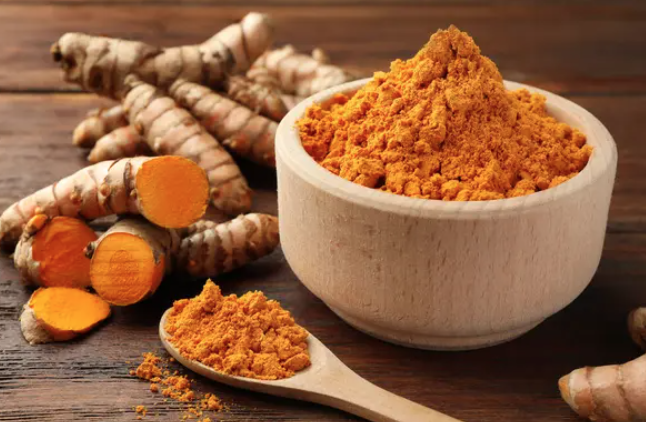
Curcuma longa
Zingiberaceae (ginger) Family
History & Growing: Native to India and Southern Asia, turmeric is grown in tropical locations as it requires humid growing conditions with well-draining soil. It is commonly propagated by root cuttings, and the mature rhizome is unearthed and harvested in the winter. The root is broken into pieces and often steamed or boiled prior to drying. Turmeric boasts a bright orange flesh.
Parts of Turmeric Used: Root (rhizome) containing curcumin, along with volatile oils like zingiberene and turmerone.
Ways to consume Turmeric:
- Tea, tincture, fresh or dried root in food, smoothies, juices, standardized extract, capsule, topical ointments.
- Turmeric may be the best example of fad herbalism! I know a lot of athletes take curcumin supplements, and family members who take turmeric capsules. Hopefully after listening to this podcast, you can save some money and incorporate turmeric in more beneficial (and tasty!) ways.
Turmeric’s Taste: Earthy, slightly spicy, mildly bitter, pungent, oily
Turmeric’s Energetics: Warming and pungent, drying
Turmeric’s Herbal Actions:
- Anti-inflammatory!
- Cholesterol lowering
- Antimicrobial (curcumin)
- Antioxidant
- Carminative (disperse wind)
- Cardio-, hepato- and neuroprotective
- Antirheumatic
- Anti-emetic
- Cholagogue (stimulates bile production & release)
- Emmenagogue (stimulate menstruation)
- Antiplatelet (blood thinning)
- Vulnerary (wound healing)
Body Systems turmeric acts upon:
- Heart & Cardiovascular system
- Liver & Digestive system
- Nervous system
- Blood & mucosa
- Reproductive
Traditional Uses:
- Turmeric has a long history in the Asian and Indian cultures.
- Turmeric was used as a jaundice treatment as well as a treatment for gastritis and digestive issues.
- Traditional uses include skin treatments, liver issues, improve circulation, joint pain and as a wound healing agent
- Used as a dye in clothing
- Haldi is the Hindi term for turmeric. Turmeric is a traditional part of the Haldi ceremony, a pre-wedding ritual where turmeric paste is applied to couple’s face, hands, arms and feet
- In TCM, turmeric is used to “circulate qi” help menstrual irregularities, heart conditions, circulate blood, and disperse wind.
- Turmeric is a key ingredient in Golden Milk, originally from India and commonly used in Ayurvedic medicine.
Current Uses:
- Commonly used as an arthritis treatment due to its anti-inflammatory properties, as well as other inflammatory condition (topical or otherwise) such as eczema, allergies, psoriasis, athlete’s foot, and asthma.
- Turmeric is commonly used a natural food colorant.
- Turmeric, with its blood thinning and cholesterol lowering, anti- inflammatory properties, is often used to reduce the risk of strokes and heart attacks.
- Turmeric has anti-emetic properties and may be effective for those experience nausea, vomiting and diarrhea. Like ginger, this tuber slightly more gentle and may help with several of the same complaints for PMS and morning sickness. Use of any herb or supplement while pregnant should be supervised by a medical professional.
- As a food herb, turmeric is often featured in a number of culinary dishes.
- Because of its neuroprotective and inflammation-lowering properties, turmeric may be a beneficial in treating diseases like Parkinson’s, Alzheimer’s and epilepsy. Cultures who use turmeric regularly in their food display lower rates of cancer and Alzheimer’s. (Body into Balance, Maria Graves)
- Turmeric may also be an ally for those who struggle with Crohn’s, colitis or other GI/digestive/stomach ailments due to its prebiotic, anti-inflammatory properties.
Studies:
- Turmeric, and its constituent curcumin, has been widely studied and researched
- Research has shown turmeric contains anticoagulant properties, which contributes to its blood thinning action. Turmeric also contributes to bile production and flow, which makes this herb a protective ally to the stomach and liver.
- Turmeric, and curcumin derived from turmeric, is poorly absorbed by the gut wall. Scientific studies encourage the traditional Ayurvedic formulation of turmeric root and black pepper to increase absorption. Studies show this can improve bioavailability of curcumin by 2,000% (Encylopedia of Herbal Medicine, Andrew Chevallier)
- “When applied to the skin and exposed to sunlight, turmeric is strongly antibacterial. Curcumin is responsible for this, and is more strongly antioxidant than Vitamin E.”
- A 2021 clinical study in India researched turmeric as an alternative treatment for Covid-19, as many of the symptoms are a result of inflammation. The study found patients who “received curcumin/piperine treatment showed early symptomatic recovery less deterioration and fewer red flag signs, better ability to maintain oxygen saturation above 94% on room air and better clinical outcomes than the control group.” Encylopedia of Herbal Medicine, Andrew Chevallier)
- Turmeric’s claim to fame is its ability to fight inflammation. On a cellular level, it does this by inhibiting pathways involved in inflammation and inhibiting production of pro-inflammatory compounds, cells and/or enzymes.
- Inhibit pro-inflammatory transcription factors (NF-κB and AP-1);
- Reduce the pro-inflammatory cytokines TNFα, IL-1b, IL-2, IL-6, IL-8, MIP-1a, MCP-1, CRP, and PGE2
- Down-regulate enzymes such as 5-lipoxygenase and COX-2 and -5;
- Inhibit the mitogen-activated protein kinases (MAPK) and pathways involved in nitric oxide synthase (NOS) enzymes synthesis
When to reach for turmeric & Dosage:
- When you’re fighting inflammation (think after a workout, swollen joints, stomach just not quite right) it’s turmeric time! Athletes who are sore from training and aging adults who suffer from joint pain may incorporate turmeric, fresh or dried, into their diet. Be aware that dried herbs from the store could be outdated.
- ¼ – ½ teaspoon of dried ground root counts as a serving.
- I often buy the fresh root once a month or so from Safeway and use it in carrot-turmeric-orange juice, bone broth, and tea. You may use more fresh herb than dried, and I probably use closer to a tablespoon per serving because I love the flavor. It does stain things orange, but the brighter the stain the stronger the medicine! It makes a wonderful chai tea, which appropriately features black pepper to increase absorption of turmeric. I’ve used powdered turmeric as an OK substitute, but – to me – there is nothing like the fresh root.
- You can use turmeric in smoothies, juice, tea, or add it into foods like soups and marinades. Heat improves the bioavailability. If appropriate, you could have it in standard doses daily.
- Follow dosage instructions on product label if you’re using a capsule or standardized extract.
- Remember that turmeric, and its constituent curcumin, is not absorbed into the gut wall on its own, particularly in a capsule or extract. This is why I see curcumin supplements as a waste of money. Pairing fresh or dried turmeric root with foods is, in my opinion, the way to go!
Contraindications: Those on blood thinning medications should use caution, as turmeric has blood-thinning actions. Also, those with kidney or gallstones present should exercise caution; turmeric contains oxalic acid. Because turmeric is warming, and often accompanied by black pepper, it may aggravate stomach ulcers and/or reflux.
Planetary, Elemental and Dosha Associations:
- Due to turmeric’s warming properties, and bright orange flesh, it is associated with the Fire element. Because of its warm, drying nature, turmeric may be contraindicated for the pitta dosha, and those with patterns of dryness and/or heat. Turmeric is very pitta in nature (oily, hot)! For dry, achy joints, for example, turmeric may not indicated, or used as a stand-alone herbal remedy, otherwise the condition may worsen. This herb comes to mind when working with the kapha dosha. Like I mentioned in my ginger episode, as a pitta dosha I use turmeric often, but not daily.
- Turmeric, to me, seems to come under Jupiter’s rulership. It’s warm and oily, with actions on the liver and digestive system, which is very Jupiter in my eyes!
 Kawaoka Coaching
Leave a comment